
1730 Holder Lane, Northfield, IL 60093 800-323-8267 . bergmannlab.com
Orthotics
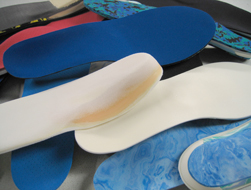
Custom Orthotics
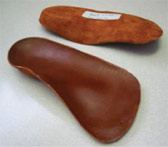
Metatarsal raises can be used in all three lengths.
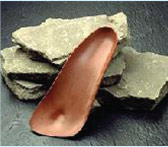
Pocket accommodations can be used to shift weight off any plantar area.
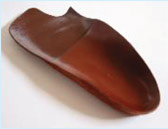
Area of excessive wear can be cut out if desired.
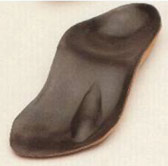
Orthotic can be used for any intermetatarsal neuroma.
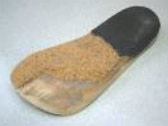
The orthotic has a shaft raise extending under the first head.

A high medial flange can reduce pressure on bony prominences.
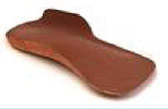
The lateral heel flange is used with all three orthotic lengths.
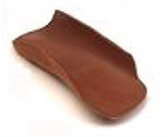
The full-length lateral flange is used as an additional width spacer.
Tailor’s flange hallux valgus flange
High heel collar
Low heel collar
Sponge front
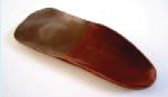
Molded sponge forefoot
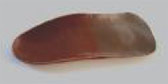
Molded Corlyte™ forefoot
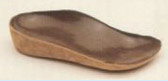
Heel raise
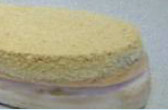
Sponge heel
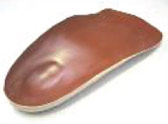
Spur pocket sponge heel
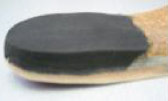
Spur pocket sorbothane laminate heel
Leather Balance Orthotics — Local Accommodations
Along with balance wedging, we have found certain corrections and accommodations useful for relief of local symptoms when surgical intervention is not advisable. They are listed below with what we have found to be their best uses, along with the lengths of orthotics they can be used with most effectively. These corrections and accommodations can be used on all the material types previously listed.
Metatarsal Raise on Top
It is used with multiple intermetatarsal neuromas, after metatarsal head resection, and it also works well in combination with pocket accommodation for relief of intractable plantar keratosis. Metatarsal raises can be used in all three lengths.
Metatarsal Raise on Bottom
It is used for elongation of contracted digits, multiple intractable lesions, where metatarsalgia affecting several heads is involved, or after pan metatarsal head surgery. Can be used in all three lengths, but it is most effective to the sulcus or full length to the end of toes.
Pocket Accommodations
Most effective method for relief of metatarsal head lesion. It can be used to shift weight off any plantar area. This method is not as effective when more than three metaheads are involved; then it’s best to use a metatarsal raise on bottom instead of pocket accommodations when three or more heads are involved on one foot. Be sure areas to be pocketed are marked accurately on the foot with an indelible pencil before casting the patient. It can be used in sulcus length and full length to end of toes.
Cutout Instead of Pockets
Not as effective as pocket accommodations for relieving pressure. Should not be used in combination with full-length orthotics. The most accurate method for locating the area to cut out is to allow the patient to wear sulcus length for two weeks, then cut out the area where excessive wear is present. If desired, we will cut out the area, but be sure to mark metatarsal heads involved with an indelible pencil before casting. Used in sulcus length only.
Morton’s Neuroma Raise
Classically used for inoperable so-called Morton’s Neuroma in third intermetatarsal space; however, it can be used for any intermetatarsal neuroma. It can also be used in the treatment of heloma molle found at fourth interspace. It is most commonly used sulcus length, but it may also be used with full-length orthotics. It is not as effective with metatarsal head length orthotics because the distal aspect of the raise ends too far proximal since the orthotic ends proximal to metatarsal heads.
Morton’s Syndrome
Morton’s Syndrome is sometimes confused with Morton’s Neuroma. As shown here, the orthotic has a shaft raise extending under the first head. It is commonly used when there is an elevated first metatarsal head in relation to the rest of the metatarsals. This is a classical Morton’s Syndrome foot. It may also be used in forefoot varus or along with a medial heel wedge to reduce abduction related to over-pronation. Many doctors use this raise when they see a short first metatarsal on x-ray in relation to the second metatarsal. But in many cases, this is actually a plantar flexed metatarsal head, which would contraindicate the use of a Morton’s Syndrome extension. As a rule, shaft raises should never be used on prominent plantar flexed metatarsal heads. The orthotic can be used in sulcus length or full length. With metatarsal head length orthotics, an extension for the first metatarsal head may be added, but it is usually not as effective.
High Medial Flange
A high medial flange gives extra medial support without pinching along the apex of the medial aspect of the arch area. It can also be used along with pocket accommodations to reduce pressure on bony prominences. As with any flanges, you will need extra width in the shoe to fit in the medial flange.
Lateral Heel Flange
Used to stabilize and prevent rotation of the rear foot in the orthotic in cases of very narrow heels or severe rear foot varus. It is used with all three orthotic lengths.
Full-Length Lateral Flange
Used as additional width spacer in shoe for cases where one foot is narrower. It helps to prevent forward slippage of the narrower foot in the shoe. It is also used for stabilization in cases of severe rigid forefoot valgus. It is used in combination with pocket for lateral plantar protection of the fifth metatarsal base. In most cases, you will want to have orthotic length to be sulcus or full length. Extra shoe room may be needed.
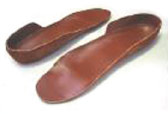
High Heel Collar (heel flange)
This is used to add additional protection for sensitive heel areas or give some rearfoot control. Conditions such as retrocalcaneal bursitis, heel fractures, heel deformities, and partial heel amputations can be accommodated to reduce pressure. Extra shoe room is required.
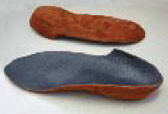
Low Heel Collar (heel flange)
This heel flange is about three quarters of an inch higher than our normal leather heel cup. It is used where a slightly deeper heel cup is preferred. Best to use with regular leather top, as it forms better than when vinyl or cushion tops are added.
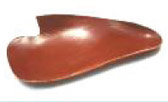
Tailor’s Flange Hallux Valgus Flange
This is used in cases of inoperable hallux or tailor bunion to relieve medial or lateral side pressure from shoes. Shoe room has to be available to use these flanges. It is used in sulcus and full length.
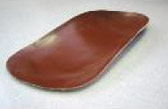
Sponge Front
Regular leather shell is sanded thinner in forefoot and soft sponge fill is placed underneath to provide mild forefoot cushioning.
Molded Sponge Forefoot
This has a very soft front with calfskin top cover over soft sponge fill. Used for sensitive forefoot areas, such as hypersensitive feet or fat pad atrophy arthritis. It can be used in combination with cork or sponge fill-in to allow some rearfoot control. It is used with sulcus and full-length orthotics.
Molded Corlyte™ Forefoot
This is the same as the Molded Sponge Forefoot, but it has a Corlyte™ fill. Some feel this material is more resilient. They are very similar, but the Corlyte™ fill is slightly firmer than the sponge fill material.
Heel Raise
Heel raise of up to 3/8’’ can be incorporated in regular shoe. After 3/8’’, it is best to use an Orthotic Depth Shoe. In up to 3/8’’ heel raise, metatarsal head and sulcus length can be used. After 3/8’’, it is best to use full length with levy mold crest to prevent sliding forward in the shoe.
Plastic Reinforced Arch
Material used is 2mm acrylic plastic, which is added to the longitudinal arch for extra reinforcement. Use it for conditions such as heavy or active patients. Don’t use it for high arch feet, as it usually is not tolerable. In that case, ask for sponge or Corlyte™ reinforcement.
Sponge Heel
A 1/4’’ sponge heel added to the leather orthotic for such conditions as heel spur syndrome, calcaneal apophysitis, soft heel raise, and for soft rearfoot neutral posting.
Spur Pocket Sponge Heel
1/4’’ sponge heel as above, but with heel spur pocket added. Used for such conditions as heel spur syndrome and scar tissue on heel area.
Sorbothane Laminate Heel
Same design as sponge heel, but made with sorbothane for a slow recovery and dampening down effect on impact. Used in same conditions as sponge heel, except it is not as effective as the sponge heel as a neutral heel post.
Spur Pocket Sorbothane Laminate Heel
Same design as spur pocket sponge heel, but made with sorbothane for a slow recovery and dampening down effect on impact. Used in same conditions as spur pocket sponge heel.